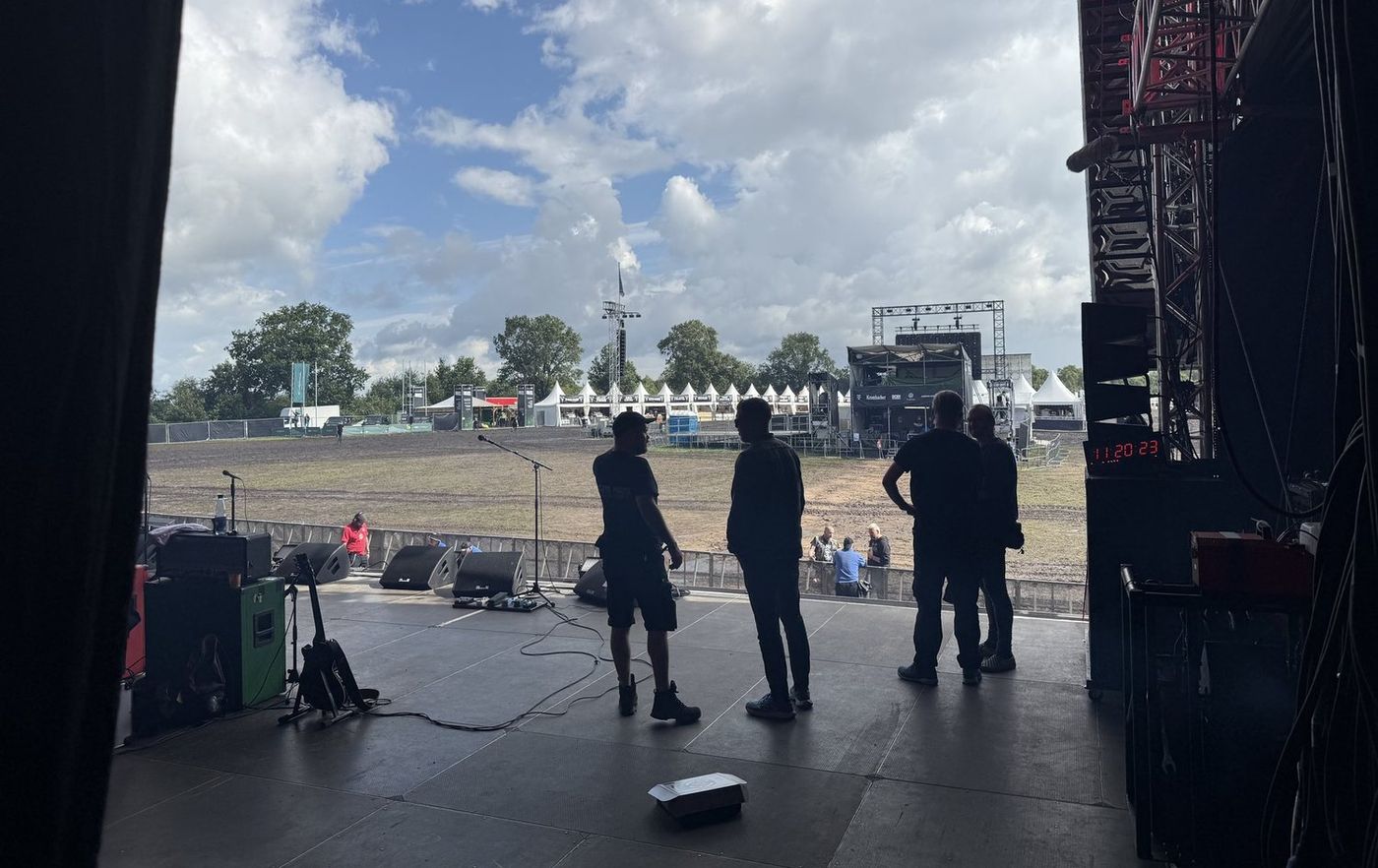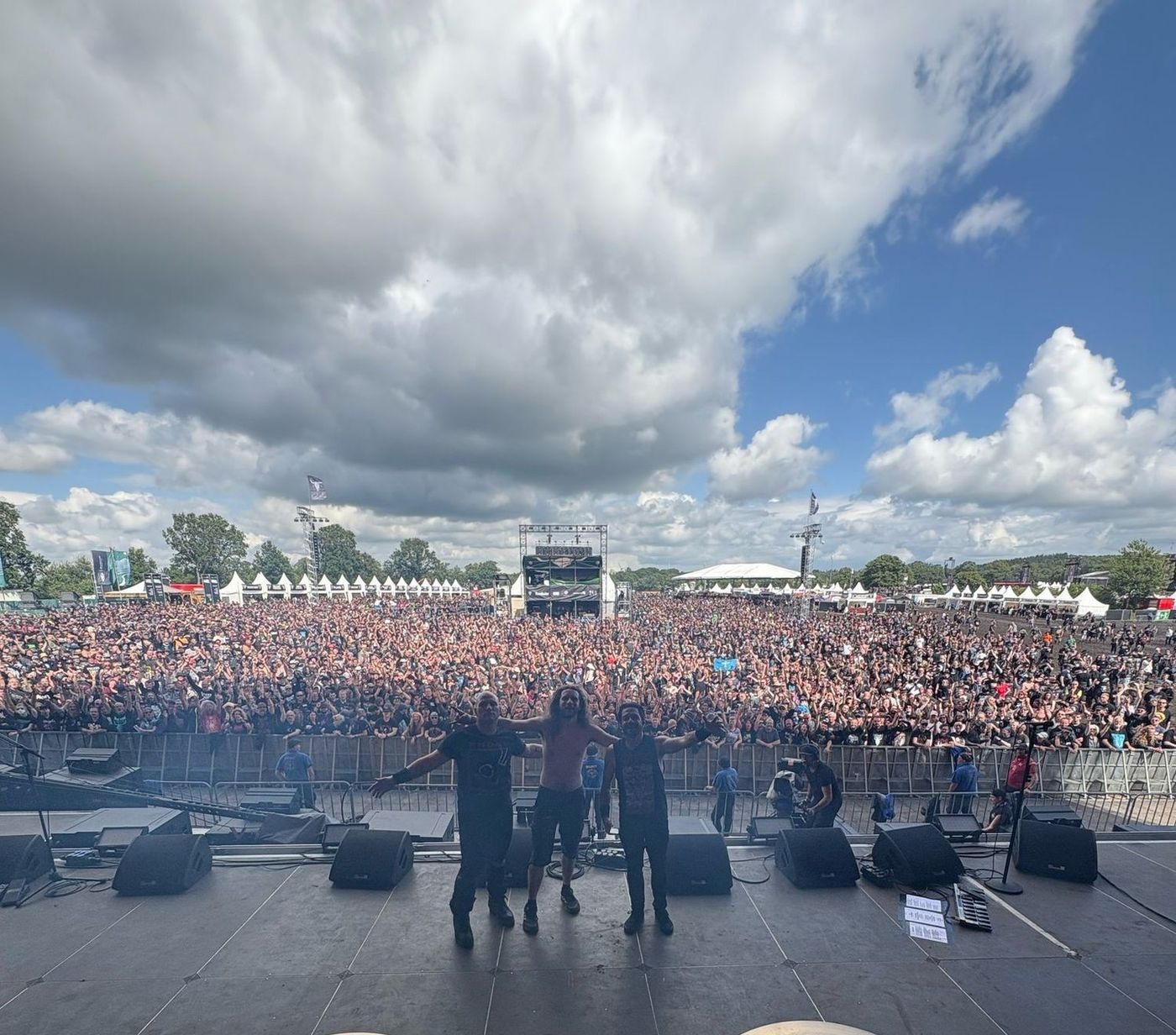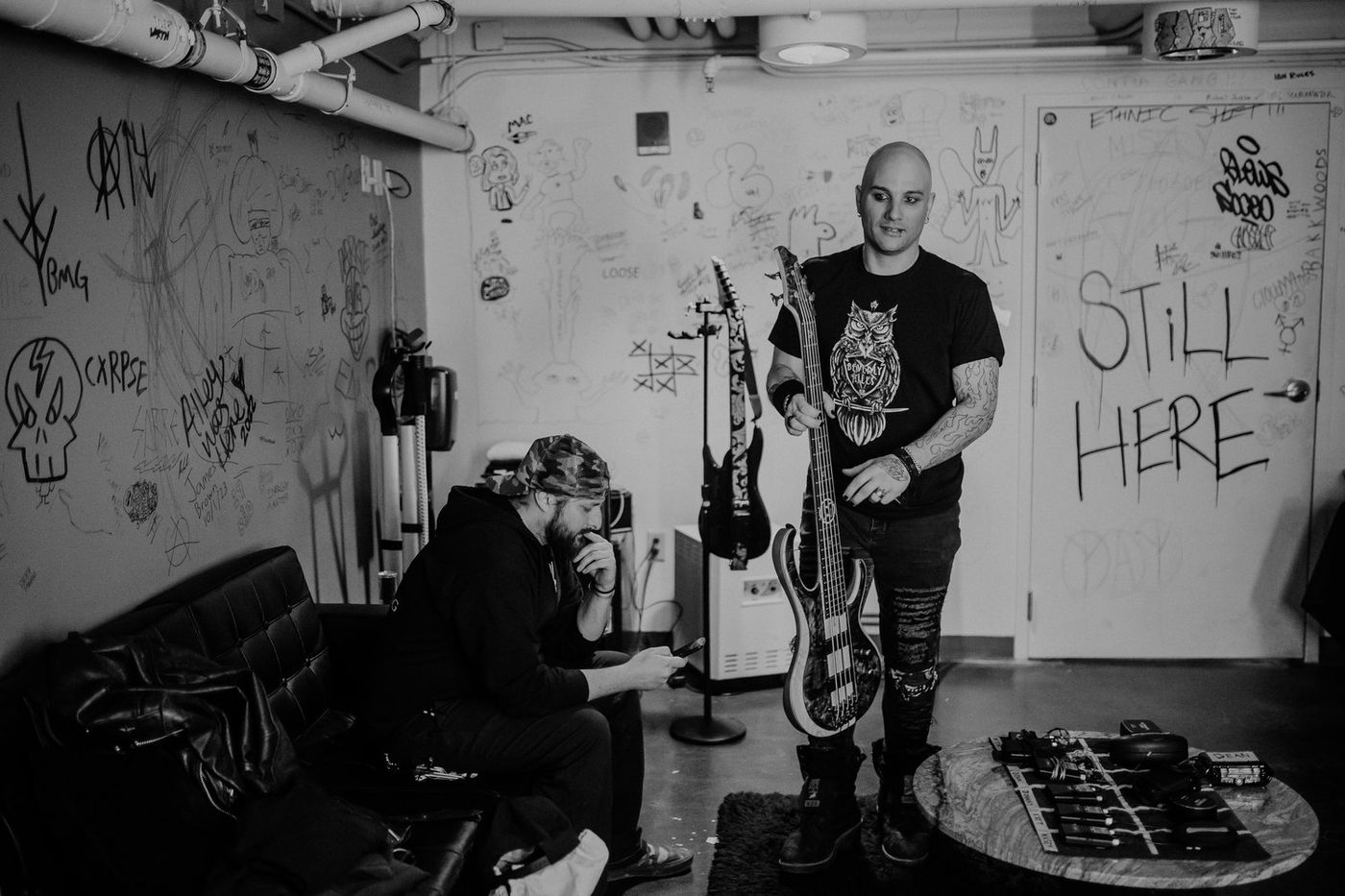
Green room, Nita Strauss tour. Photo: Ana Massard.
Before I could play a chord, I was handing my Pop wrenches under a 1960s Mustang. When we couldn't find a part, we made one from scratch. He gave me my first guitar at 13 — a $79 damaged-display Ibanez I took apart before I ever tuned it — and I've been chasing tones ever since.
I came up in the New Jersey scene, then spent thirteen years on the road: 200+ shows as Nita Strauss's bassist through a #1 Active Rock campaign, about a hundred nights with Michale Graves of the Misfits, guitar and bass for Darkness Descends, Darrow Chemical Company and Alyxx, and tech and crew work for Static-X and Dope. Guitar tech on Demi Lovato's HOLY FVCK. In 2019 I was Prong's guitar tech on the run with Agnostic Front and helped tour manage it alongside Rodger from AF — years before I ended up in the band. Festival stages from Wacken to Aftershock. Today I play bass and run production for Prong.
Why does the world just make sense to me when I have my guitar in my hands? I've been asking that since I picked up an axe almost thirty years ago, and I still don't have a clean answer. What I do have is the lunchpail mentality that turned the question into a job.
Half analog, half digital
My music education was half analog and half digital — part of it learned off records and out of a teacher's hands, part of it learned off a screen. That split is the whole reason the Dead Sea Scales books look and read the way they do. The Dead Sea Scrolls are semi-forbidden documents that add an extra layer to one of the world's oldest religions, and that's what I'm doing with music on the guitar. Papyrus with circuit-board traces where the Hebrew should be.
The system exists because I lost years in what I used to call a stagnant pool of never-ending noise — chromatic runs made up to get my hands faster, with nowhere to go afterwards. Nobody handed me the map. I wrote the one I wish I'd had, so the next kid with a beat-up guitar doesn't need thirty years to see the whole fretboard.
What I teach
All I really want to do is share my experience, so that through my mistakes other players have greater success and skip a few of the pitfalls. The physical technique is the easy half. The hard half is that learning anything new is a mental fight, and almost nobody sees your wins — every time I finally landed a run I'd been chasing, I was alone in a room with a metronome. No crowd, no band, nobody to witness it. Our biggest accomplishments go unnoticed, and even when someone does see one, they have no idea how many hours are underneath it.
So the rules I teach from are simple. Don't forget to have fun. Don't treat it like work — just play. It matters less how long you practise than what you play while you do. If you want to run with ease, first find the most efficient way to walk, which sometimes means crawling: the real secret to playing fast is going painfully slow and fixing what you find. And music itself is tension and release through melody and beat — intervals, the space between notes, are the whole game. A note only makes you feel the way it does because of the ones around it.
I run my own work in cycles — write, learn, perform, perfect, record, move on — because attention moves in cycles whether you plan for it or not. Learn your own and you stop wasting the good hours.
Off the fretboard
I write outside of music too. The Possibilities of Acceptual Sciences started at midnight after a sixteen-hour day driving an eighteen-speed dump truck, with a thought I couldn't put down: if I can think about it, why can't it happen? It's an argument that possibility carries its own weight, and that most of what we call impossible is just missing information. The Book of Dean is the plainer version of the same idea, aimed at players.
Pop had a saying I've run my whole career on: "It's easier to create than it is to destroy." He was wrong about the easy part. He was right about which one is worth doing.